We rarely stop to appreciate how much complexity sits beneath the surface of industries we take for granted every day, and freight and transport in Australia is one of the best examples of this.
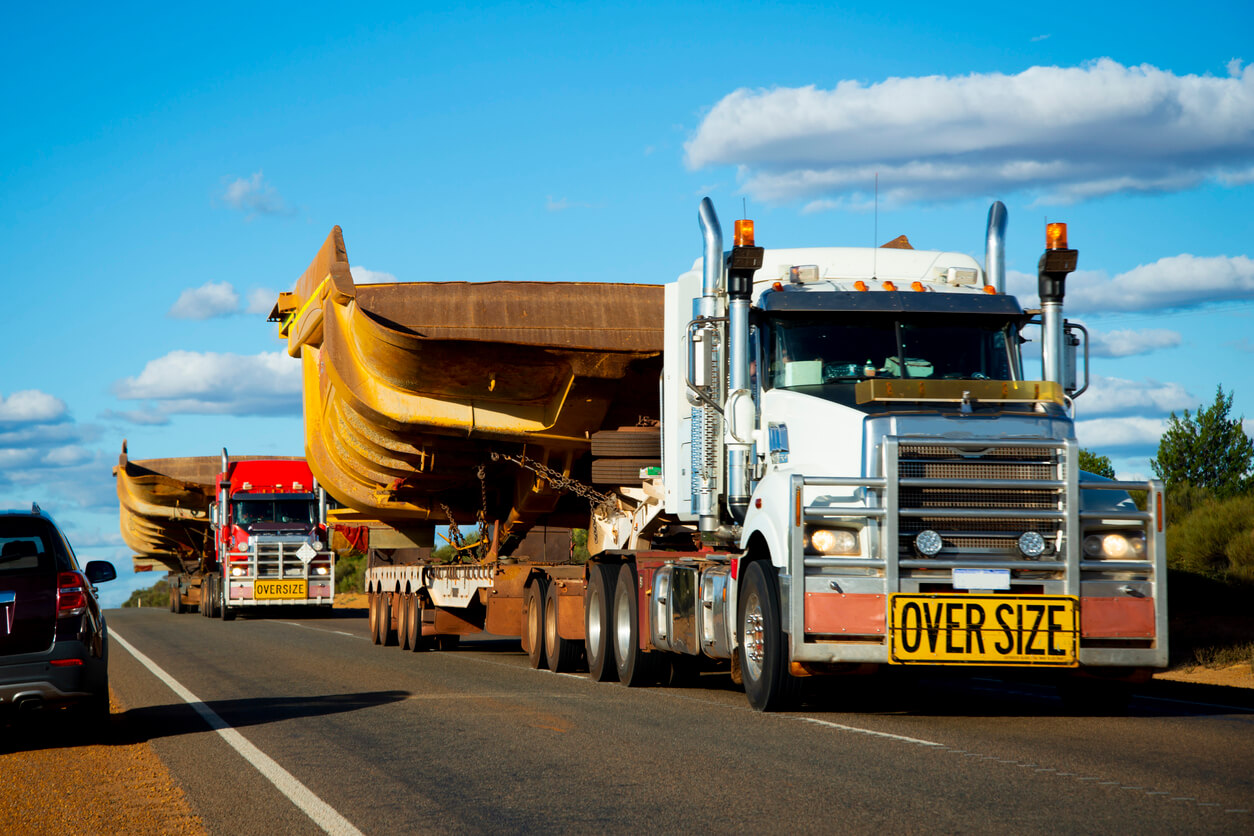
Most of us have seen an oversize convoy on the highway at some point. A wide truck flanked by escort vehicles, amber lights flashing, moving carefully through traffic. It is easy to drive past and think nothing more of it. But what you just passed was not a simple delivery. It was the result of days to weeks of planning, government permits, route surveys, safety assessments, and precise coordination between multiple teams. That brief moment on the road represents one of the most complex operations in Australian freight. When you look closer, you’ll find a sophisticated, safety-driven industry that keeps the country’s biggest infrastructure projects moving.
In this post, we will walk you through what oversize and overmass (OSOM) transport actually involves, why it matters, what the regulations look like in NSW, and how On Time Freight Management helps businesses move even the most challenging loads nationwide.
What is Oversize and Overmass (OSOM) Transport?
OSOM stands for Oversize and/or Overmass. It refers to any vehicle or load that exceeds the standard size or weight limits permitted on public roads under the Heavy Vehicle National Law (HVNL).
In practical terms, a load is classified as OSOM when it physically cannot comply with the prescribed mass or dimension requirements, and when dividing the item into smaller parts is not a realistic option. Under the HVNL, these are formally referred to as Class 1 load-carrying vehicles.
The kinds of loads that fall into this category include things like:
- Wind turbine blades and tower sections
- Bridge beams and structural steel components
- Mining and drilling equipment
- Mobile cranes
- Agricultural harvesters
- Large construction machinery
- Industrial generators and transformers
These items do not come apart easily, and in many cases, they cannot be broken down at all. Specialised oversize freight transport is the only viable way to move them safely.
What Qualifies as Oversize in NSW?
Standard heavy vehicles in New South Wales operate within fairly defined limits. Once a load pushes beyond these, it enters OSOM territory and must follow a separate set of rules.
The general limits for standard heavy vehicles in NSW are:
- Width: up to 2.5 metres
- Height: up to 4.3 metres
- Length: up to 19 metres for most combinations
Anything beyond these figures typically requires permits, approved routes, and in many cases, Transport Management Plans (TMP) and escort vehicles.
When Does a Move Become High Risk?
Not all OSOM movements are treated the same way. Transport for NSW classifies certain moves as “High Risk” based on their dimensions or weight, and these require a formal Transport Management Plan (TMP). A TMP must document how the movement will be carried out safely, including route surveys, traffic management arrangements, and community consultation where relevant.
Under current NSW guidelines, a move is classified as High Risk if, among other criteria, it involves:
- A total length greater than 40 metres on single carriageway roads
- A width greater than 6.0 metres
- A height greater than 5.2 metres and within 200 millimetres of an overhead structure
- A total combination weight exceeding 184.5 tonnes
For moves involving potentially hazardous materials, such as loads with radiation, chemicals, or corrosive substances, they are further classified as Critical or Sensitive loads, which triggers additional requirements.
You can find the full breakdown of OSOM classification and permit requirements on the Transport for NSW website.
Route Planning and Permits
Before any OSOM movement can begin, the operator needs to apply for an access permit through the National Heavy Vehicle Regulator (NHVR). This process involves checking whether the proposed route falls within the approved OSOM network, identifying any level crossings that require written approval from a Rail Infrastructure Manager, and confirming that the load dimensions are within the limits of any applicable national notices or exemptions.
In some cases, travel is restricted to specific hours. Many oversize loads travel at night or in the early morning hours, particularly through urban areas like Sydney, where traffic volumes are lower and the risk of disruption is reduced. For extremely wide or long loads, night travel may actually be restricted, with the convoy required to move during daylight hours for better visibility and coordination.
What Goes Into a Transport Management Plan (TMP)
A TMP is not just a form you fill out. It is a comprehensive document that covers the vehicle and load details, a survey of the proposed route, traffic management arrangements, any relevant stakeholder and community consultations, and approvals from Rail Infrastructure Managers where level crossings are involved. Once prepared, the TMP is submitted through NHVR Go alongside the access permit application.
This level of planning is what separates a compliant, safe OSOM movement from a hazardous one. It also means that operators and drivers carry significant accountability for each journey.
Safety & Escorts
Escort and pilot requirements are set by the relevant permit or notice conditions, along with any NSW access requirements for the approved route. Transport for NSW sets clear rules around how many pilot or escort vehicles are needed based on the load’s dimensions and whether it is travelling during the day or after dark. The larger and wider the load, the more support it requires on the road.
How On Time Freight Management Handles Oversize Freight Across Australia
If you are trying to figure out the cheapest way to send large packages in Australia or move something that simply does not fit the standard freight mold, you need more than a carrier. You need someone who understands the regulatory landscape, has the right carrier relationships, and can handle the logistics without you having to navigate it all yourself.
At On Time Freight Management, we work with businesses across industries to move oversize freight shipping requirements of all kinds. From wide machinery to awkward, non-palletised items that other carriers simply will not touch, we coordinate the right solution based on your load, your destination, and your timeline.
We handle large items shipping that includes everything from heavy equipment for mining and construction to oversized agricultural machinery in regional New South Wales and Queensland. If you need oversize load trucking companies that actually understand permit requirements, route planning, and carrier capabilities, we can take that weight off your plate.
We also assist with interstate pallet freight for businesses that need consistent, reliable movement of goods across state lines, including pallet transport from Sydney to Brisbane and other major freight corridors. And for loads that fall outside standard categories entirely, our ugly freight service exists precisely for those jobs that require a more tailored approach.
Whether you are in Sydney, Brisbane, or anywhere in between, we will give you a straight answer on what your move involves and what it will cost. Request a free quote today and tell us about your load, and our team will come back to you with honest advice and a solution that works.
Frequently Asked Questions About Oversize Freight in Australia
Do I need a permit to move an oversize load in Australia, and who issues it?
Yes. Permits are issued by the National Heavy Vehicle Regulator (NHVR) through their online portal, NHVR Go. Depending on your route and load, you may also need additional approvals from state transport authorities or NSW Police. An experienced freight manager can identify exactly what is required before anything moves.
What is the difference between an oversize load and an overmass load?
Oversize refers to a load that exceeds standard dimension limits – too wide, too tall, or too long. Overmass, on the other hand, refers to a load that exceeds allowable weight limits. A load can be one, the other, or both, which is why Australian regulation uses the combined term OSOM.
How far in advance should I plan an oversize freight movement?
For straightforward moves, permits can be arranged within a few days to a week. High-risk moves requiring a Transport Management Plan, community consultation, or police escorts can take several weeks. If your project has a fixed deadline, it is worth starting the conversation with your freight provider earlier than you think you need to.